Claude Fable 5 vs Gemini 3.7 Flash — reasoning pace vs TPU stream
Same Slowtest audit, two products. Use this when you need to see whether Fable is slow because it is thinking — or because the chat will not run the harness — while Flash is a stream you can actually clock.
This pair is for production loops vs a long single-shot write. If you are drafting architecture in one sitting, Fable is the session people reach for. If you are timing a tight agent loop, you want a Generation clock on Flash (own-key is the clean path). Do not treat a faster stream as a smarter model.
Slowtest splits Generation tok/s (decode window when we have one) from full-turn tok/s (start of the job to the last token or finish beacon). Fidelity is whether Line 1 declares MODEL: and the essay stays 800–1200 words. The table below is context, not a Slowtest ledger — live numbers belong on a receipt or the Insights TPS ledger once someone pastes a real run. Method: How we measure.
Own-key hits Gemini and Anthropic from your browser. 1-paste needs a model that will POST start and finish. Fable-on-Claude-chat often refuses that hook — same Harness Restriction note as other Claude surfaces. Flash 1-paste depends on whether that Gemini UI will POST; if it will not, stream it.
| Metric / Attribute | 🎭 Claude Fable 5 | ⚡ Gemini 3.7 Flash |
|---|---|---|
| Output Generation Velocity | 12 – 22 tok/s (Deliberate) | 160 – 215+ tok/s (Blazing TPU) |
| Time-to-First-Token (TTFT) | 1.2 – 2.8 seconds | Sub-400ms (< 0.4s) |
| Hardware Architecture | Distributed GPU Clusters (AWS/GCP) | Custom Google TPU v6 Pods |
| Context Window & Cache | 200k – 500k tokens | 2,000,000+ tokens (Zero lag) |
| Throttling Susceptibility | Frequent peak-hour token choking | Rare (Google compute redundancy) |
| Ideal Deployment | Complex single-shot architecture design | High-frequency agent loops, live tools |
Claude Fable 5 Explicitly Labeled "With Fallback"
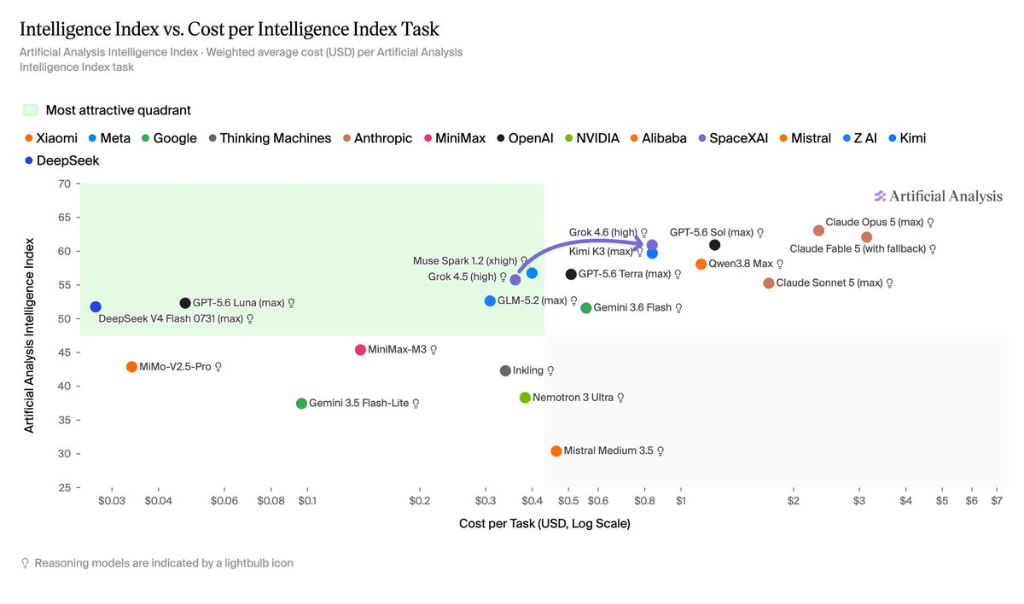
Independent tracking by Artificial Analysis highlights the exact operational reality: Claude Fable 5 is tracked "(with fallback)" at ~$2.50 per task, reflecting cluster coprocessing during peak demand. Meanwhile, Gemini Flash delivers high intelligence near the attractive cost/speed quadrant.
Three questions for this pair
When is Flash the right Slowtest, and when is Fable?
Clock Flash when you care about stream throughput and TTFT on a short leash (own-key). Clock Fable when you care how a reasoning chat behaves on the same 800–1200 word audit — including whether it will talk to the harness at all.
If Flash is much faster, did Fable fail fidelity?
Not automatically. Fidelity is Line 1 plus word-band. A slow Fable run at 100% fidelity is still a pass. A fast Flash run that skips MODEL: or overshoots 1200 words is a miss. Speed with a miss is not a score.
Can I compare them with no API keys?
Yes, via 1-paste or the keyboard worksheet. Expect Claude chat to refuse the beacon more often than a Gemini surface that can POST. Own-key is the honest Generation clock when you have keys. Details: Insights.
Test your active session against these benchmarks
Run Slowtest's 1-paste standardized benchmark to reveal your exact tokens/second velocity and check for silent downgrades.
⚡ Audit Your Active Session Free ➔If you haven't tried open source, you've been waiting too much for your favorite frontier model.
Tired of waiting on closed compute queues? Switch to high-velocity edge-routed models:
Abacus.AI ChatLLM
Run Claude 3.5 Sonnet, GPT-4o, and Gemini with blazing edge-routed inference without single-model rate limits.
Try Abacus Free ➔Monica AI Assistant
Instant access to DeepSeek, Qwen 2.5, GLM-4, Claude & GPT-4o on blistering-fast hosted hardware with zero setup.
Try Monica Free ➔Sider AI Assistant
Run DeepSeek, Claude, and ChatGPT side-by-side inside any webpage or document with seamless browser integration.
Try Sider Free ➔